Most guides to modern living room wall decor treat every wall as the same blank rectangle, then hand you a pile of canvases, mirrors, and shelves. Real walls differ. The one behind your sofa, the one beside a window, and the long stretch of an open-plan room each need a different move. This guide sorts ideas by the wall you’re facing, with realistic prices, room sizes, and honest trade-offs.
Read your wall first: three questions
Skip this step, and you risk buying the right piece for the wrong wall.
1. What is the wall next to? Art that ignores its neighbors looks stranded. Above a sofa, aim for roughly two-thirds of the sofa’s width. Some designers go up to three-quarters.
2. When do you actually see it? A wall you glance at in daylight rewards mirrors and texture. A wall you mostly see in the evening needs its own light, and sconces on either side of a piece do that job well.
3. What is it competing with? A window view, a TV, or a busy dining zone will win any contest. Make the wall’s decor quieter than whatever it’s competing with, not louder.
“Modern” is mostly restraint: a few larger pieces, two or three colors, and some deliberately bare wall. It doesn’t have to mean cold. Texture and warm neutrals keep it from feeling sterile. If you’d rather choose by product type, budget, and lease, our best types of living room wall decor for a modern aesthetic sort options that way.
The wall behind the sofa
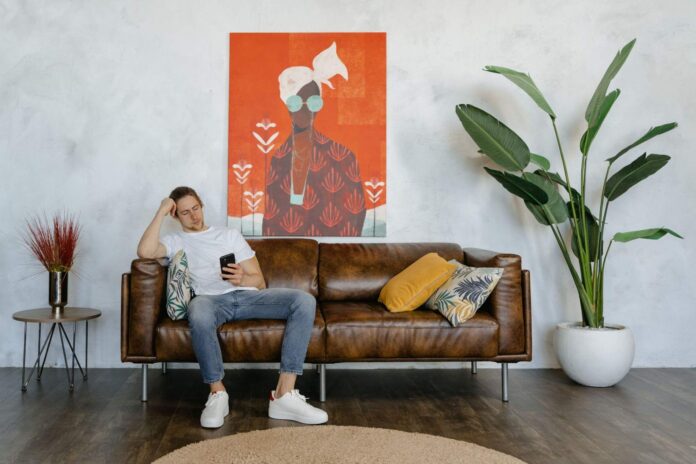
Style: Modern, Minimalist. Suits: medium to large living rooms. In a studio, shrink the idea to a single piece.
The move: one oversized piece, or a matched pair, centered on the sofa. A large abstract or line-art print in a thin black frame is the modern default. It’s also cheap: Kmart Australia sells a 61 × 91.5 cm poster frame for A$20 and a 90 × 60 cm framed canvas for A$28. Thin aluminum frames at IKEA in the US run roughly $13–45 each. If you’re still sourcing the art itself, here’s where to buy affordable living room wall art online and what it really costs on your wall.
Hang the bottom edge 6–8 inches (15–20 cm) above the sofa back, though sources range up to 10. On a tall-backed sofa, that gap matters more than the usual 57-inch eye-level rule, so let the center sit higher.
Before: a blank wall that leaves the sofa looking adrift. After: one anchor that organizes the whole seating area.
Honest take: cheap frames look fine from across the room, but plastic glazing and a flimsy feel show up close. That’s fine for prints and not for original art.
The wall opposite a window
Style: Modern, Scandi. Suits: small, narrow or dim living rooms.
The move: a large mirror across from the window to bounce daylight deeper into the room. IKEA’s round LINDBYN is a typical pick. In Australia, the 80 cm size is A$79.99, and the 110 cm is A$139. In Europe, the 80 cm size is €49.99. Expect roughly $50–80 in US dollars for a mirror around 80 cm (31½ in).
Add a pair of sconces beside it. IKEA’s VARPTROSS plug-in lamp is about $30 each. Check the product page before buying any wall lamp, because many are wired-in and need an electrician.
Before: a flat wall facing a bright window, with a dim corner beside it. After: window light carried across the room, plus a layered glow at night.
Honest take: a mirror doubles whatever faces it, so keep clutter off the opposite wall. Glass is heavy, so use anchors rated for your wall type. In Australia, the sunniest windows usually face north, so check where direct sun lands before putting a mirror or print in its path.
A narrow wall or the gap between two windows
Style: Modern, Contemporary. Suits: apartments and any room with slim wall sections.
The move: follow the wall’s shape. A tall narrow mirror, a tall framed print, or a single sconce adds height without crowding. Wide pieces near trim or curtains make the strip feel squeezed. IKEA’s slim LINDBYN (40 × 130 cm) is A$69.99 in Australia and €39.99 in Europe, so roughly $40–70 in USD. A smaller 28 × 60 cm version costs about €18.
Before: a bare strip that makes the windows feel unfinished. After: a deliberate vertical accent that frames them.
Honest take: a narrow mirror reflects whatever is opposite it, so check the view before you drill.
A long open-plan wall
Style: Modern, Japandi. Suits: large living rooms, open-plan living-dining areas and studios.
The move: treat the wall as one composition that spans both zones. A picture ledge lets you lean two or three large frames and swap them without new holes. IKEA’s MOSSLANDA ledge in the 45¼-inch (115 cm) size is $19.99 in the US and £13 in the UK. Overlap a large frame with a smaller one, and put a console or sideboard underneath so the art isn’t floating.
Before: a long blank wall seen from the front door and the dining table. After: one calm band of art that ties both zones together.
Honest take: MOSSLANDA is light-duty fibreboard. It holds frames up to 45 cm tall and roughly 5–7.5 kg depending on length, and one buyer reported a ledge splitting. It’s fine for prints but wrong for heavy mirrors or ceramics. It also needs drilling, so it doesn’t suit no-hole renters.
The TV wall
Style: Modern, Minimalist. Suits: any room with a mounted or console TV.
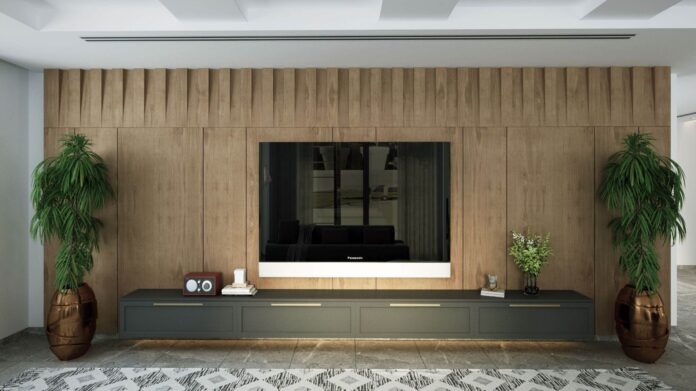
A TV is a black rectangle for half the day, so this wall has to work with the screen on and off. Keep the surrounding decor quieter than the screen and anchor it with one or two related pieces, not a collage. Our living room decor TV wall ideas cover both states in detail.
Frequently Asked Questions
How do I decorate a narrow wall or the gap between two windows?
Use vertical shapes that follow the wall’s height: a tall narrow mirror, a single tall framed print or one sconce. Keep wide pieces away from window trim and curtains so the wall doesn’t feel squeezed. Pick one element rather than several, and check what a mirror will reflect before you hang it.
Should I hang a mirror opposite a window in a living room?
Usually yes, especially in a small or dim room, because the mirror bounces daylight deeper into the space. Check what it will reflect first: it doubles whatever faces it, so avoid pointing it at clutter or a bright direct-sun spot. Glass is heavy, so use anchors rated for your wall type.
What can I put on a large living room wall besides art?
Mirrors, wall-mounted picture ledges, floating shelves, wood slat or fluted panels, wallpaper or a mural, and a sideboard or console with a mirror above all work. Pick by the wall’s job: ledges for swappable displays, mirrors for light, panels for texture. Leave some bare wall so the room still feels modern.
How do I light wall art in a modern living room?
Place a wall sconce on each side of the piece, or use a picture light above it, so the art stays visible after dark. Choose plug-in styles if you rent or don’t want an electrician, and check the product page, because many wall lamps are wired-in only.
Quick-reference table
| Wall | Style | Best move | Approx. cost (USD) | Best for | Renter-friendly? |
|---|---|---|---|---|---|
| Behind the sofa | Modern, Minimalist | One oversized print or matched pair | $13–45 per frame | Medium to large rooms | Usually, with hooks rated for the weight |
| Opposite a window | Modern, Scandi | Large mirror plus pair of sconces | Mirror about $50–80; sconce from about $30 | Small, dim or narrow rooms | Leaning mirror and plug-in sconces: yes |
| Narrow or between windows | Modern, Contemporary | Tall slim mirror or print, one sconce | About $40–70 | Apartments | Yes |
| Long open-plan wall | Modern, Japandi | Picture ledge with leaning large frames | About $14–25 per ledge | Large rooms, open plan, studios | Needs drilling |
| TV wall | Modern, Minimalist | Quiet, related pieces | Varies | Any room with a TV | Depends on mounting |
Decision summary: start with the wall you see most from where you sit, pick the one move in its row, and live with it for a week before adding a second.